Do You Need Council Approval for Shade Structures in NSW? In NSW, a shade structure may be constructed without any council approval whatsoever, as long as it complies with all the requirements of state planning legislation. That’s a significantly different response from most other states, and it’s because of one instrument that applies across the state that establishes consistent rules from Tweed Heads to Albury.
This guide outlines the three approval pathways in NSW, the specific size and siting restrictions that determine which pathway applies to you, and why commercial shade structures are typically not exempt.
The Short Answer
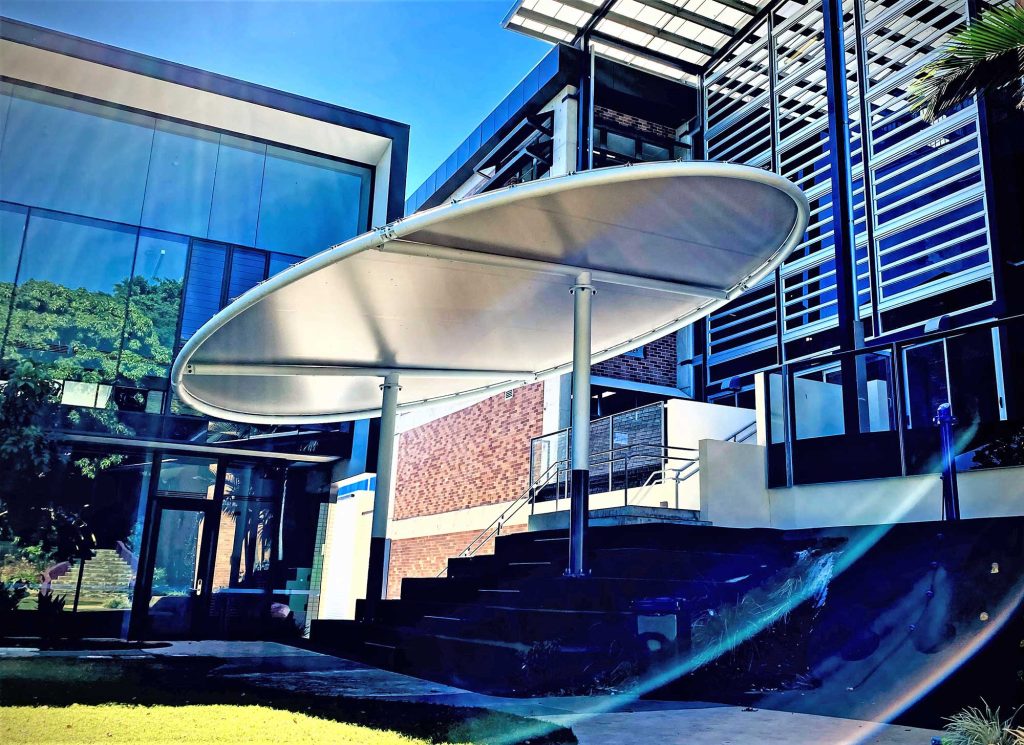
A shade structure made of canvas, fabric, mesh or similar material can be built as exempt development – meaning no council approval and no application – if it satisfies all of the development standards in the State Environmental Planning Policy (Exempt and Complying Development Codes) 2008, known as the Codes SEPP.
The headline limits are a maximum height of 3 metres and a maximum area depending on land use: 20m² for residential, 30m² for most other uses and more for child care facilities. If you miss one of the standards, you enter the complying development or full development application.
Three Pathways, Not Two
NSW sorts all development into three tiers under the Environmental Planning and Assessment Act 1979.
Exempt Development
No approval of any kind. No application, no fee, no certifier. The structure simply must comply with every relevant standard. This is the pathway most small shade structures take.
Complying Development
A fast-tracked approval issued as a Complying Development Certificate (CDC) by either the council or a registered private certifier. It is applicable to development that is predictable and low impact but not exempt from the standards.
Development Application
A full merit assessment by the council. This applies where the proposal exceeds both the exempt and complying standards, or where the site carries constraints that rule out the faster pathways.
The Statewide Advantage
Because the Codes SEPP is a state instrument, the exempt development standards are broadly the same across every local government area in NSW. A shade structure that is exempt in Byron Shire is exempt in Wollongong. That consistency is a genuine advantage for anyone operating across multiple council areas, and it contrasts sharply with states where each council applies its own thresholds.
What does vary by location is zoning, and the overlays and constraints attached to a particular parcel of land — which is why the standards below include zone-specific setbacks.
Exempt Development Standards for Shade Structures
Shade structures are dealt with under Subdivision 36 of the Codes SEPP — “Shade structures of canvas, fabric, mesh or the like”. Clause 2.71 specifies what qualifies, and clause 2.72 sets the standards.
Maximum area, by land use
This is the standard most people get wrong, because the limit changes depending on what the land is used for:
- Residential uses – 20m²
- Centre-based child care facility in a residential zone – 40m²
- Centre-based child care facility in a zone other than residential – 60m²
- Any other use – 30m²
There is also a cumulative cap: the total area of all such structures on the lot must not exceed 15% of the ground floor area of all buildings on the lot.
Height and siting
- Not higher than 3 metres from existing ground level
- Setback from each lot boundary of at least 5 metres in Zones RU1, RU2, RU3, RU4, RU6 or R5, or 900 millimetres in any other case
- Located behind the building line of any road frontage
- Not constructed on land in a foreshore area
Materials and construction
- Metal components must be low reflective, factory pre-coloured materials
- If connected to a fascia, the connection must be in accordance with a professional engineer’s specifications
- Must not interfere with the functioning of existing drainage fixtures or flow paths
- On bush fire prone land and less than 5 metres from a dwelling, it must be constructed of non-combustible material
- For a centre-based child care facility, it must be constructed of non-combustible material
- On or in a heritage item, draft heritage item, heritage conservation area or draft heritage conservation area, it must be located in the rear yard
The General Requirements That Apply to Everything
Beyond the shade-structure-specific standards, clause 1.16 of the Codes SEPP imposes general requirements on all exempt development. The structure must:
- Meet the relevant deemed-to-satisfy provisions of the Building Code of Australia, or where there are none, be structurally adequate
- Not cause an existing building to contravene the Building Code of Australia
- Not be carried out on land that is a declared area of outstanding biodiversity value, or declared critical habitat
- Not be carried out in a wilderness area
- Not be carried out on land containing an item listed on the State Heritage Register, or subject to an interim heritage order
Two further practical exclusions are worth noting. Structures on public land or over a public road – even temporary ones – require approval from the relevant council or roads authority. And if the installation involves removing or pruning trees or vegetation, contact the council first, as separate approval may be required.
Attached Shade: A Different Set of Rules
Clause 2.71 carries an express note directing readers to a separate entry for awnings, blinds and canopies. If your shade is attached to a building rather than freestanding, it may fall under Subdivision 5 instead, where the standards under clause 2.10 are considerably tighter:
- Maximum area of 10m²
- Must not project beyond the external wall of the building by more than 2 metres
- At least 450mm from each side and rear boundary when fully extended
- If connected to a fascia, connected in accordance with a professional engineer’s specifications
- On bush fire prone land, constructed of non-combustible material
- In a heritage conservation area or draft heritage conservation area, located in the rear yard
- Not used for advertising
The practical consequence is that attaching a structure to a building can halve your available area. It is worth confirming which subdivision applies before finalising a design.
Commercial Shade Structures in NSW
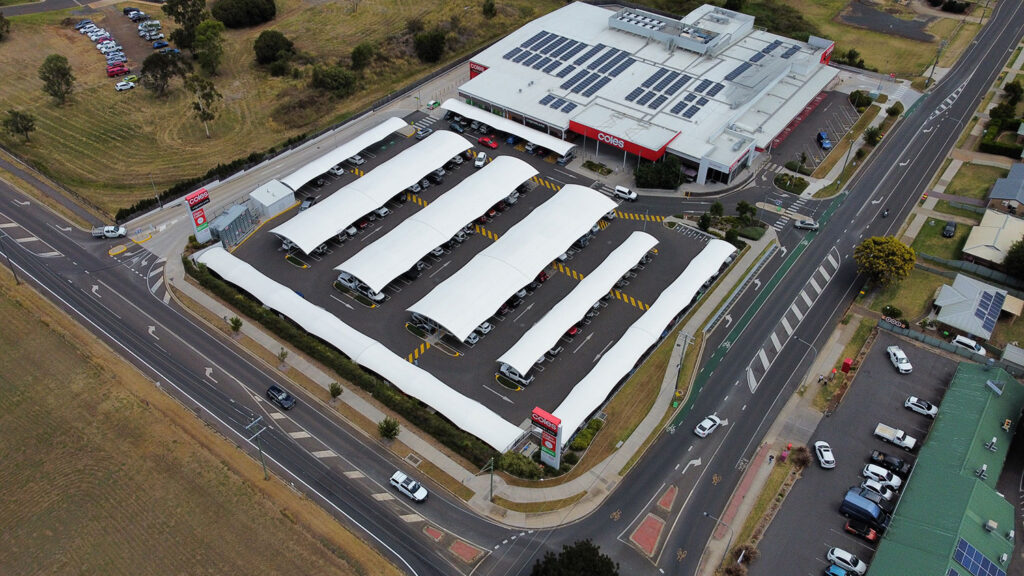
The 30m² allowance for “any other use” sounds generous until you apply it to a real commercial project. A single car parking space occupies roughly 13.5m², so 30m² covers about two bays. Car park shade, spectator cover, walkway shade and playground structures on commercial sites will almost always exceed it.
Once you exceed the exempt standards, the project moves to a Complying Development Certificate or a development application. At that point you will need:
- Certified structural engineering, including footing design appropriate to the site’s soil conditions
- Wind loading design to AS/NZS 1170.2, accounting for the relevant wind region
- Compliance with the National Construction Code
- Assessment against the relevant Local Environmental Plan and Development Control Plan
- Consideration of site constraints including bush fire prone land, flood planning areas and heritage
Schools and Child Care Facilities
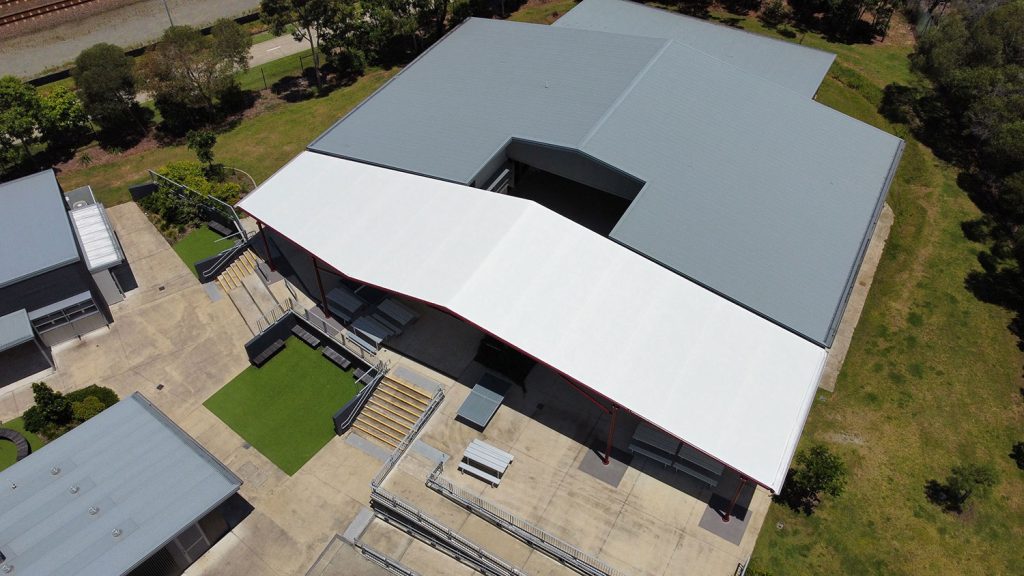
Shade structures for educational establishments and child care facilities sit in their own regulatory space. Beyond the more generous 40m² and 60m² exempt allowances for centre-based child care, development for schools and educational establishments is governed by the State Environmental Planning Policy (Transport and Infrastructure) 2021, which absorbed the former Educational Establishments and Child Care Facilities policy.
That instrument provides distinct pathways for development carried out by or on behalf of public authorities, which can materially change the approval route for a public school shade project compared with an equivalent structure on private land. If you are procuring shade for a school, establish which pathway applies before scoping the project.
Licensing: Who Can Legally Build It
Approval and licensing are separate obligations. Residential building work in NSW is regulated under the Home Building Act 1989, and contractors carrying out building work require appropriate building and trade licences.
Even where a structure is exempt development and needs no approval, it must still be structurally adequate and comply with the Building Code of Australia. Exempt does not mean unregulated — it means the compliance obligation sits with you rather than with a certifier.
How to Check Your Site
- Identify your property’s zoning, since setback requirements differ sharply between rural and residential zones
- Check whether the land is bush fire prone, in a flood planning area, or in a heritage conservation area
- Confirm the land use, because the maximum area depends on it
- Calculate the ground floor area of all buildings on the lot to test the 15% cumulative cap
- Review the NSW Planning Portal guidance on shade structures
- Where the structure exceeds exempt standards, engage a registered certifier or speak to your council early
Frequently Asked Questions
Do I need council approval for a shade sail in NSW?
Not necessarily. A shade sail of canvas, fabric or mesh can be exempt development if it is no more than 3 metres high, within the area limit for your land use, set back appropriately from boundaries, and behind the building line. If it meets every standard, no approval is required.
How big can a shade structure be without approval in NSW?
Up to 20m² for residential uses, 30m² for most other uses, 40m² for a centre-based child care facility in a residential zone, and 60m² for a centre-based child care facility in another zone — subject to the 15% cumulative cap and all other standards.
How high can a shade structure be without approval?
Three metres from existing ground level.
Do the rules change between councils in NSW?
The exempt development standards come from a statewide policy, so they apply consistently across NSW. What varies is your property’s zoning and site constraints, which affect setbacks and eligibility.
Do commercial shade structures need approval in NSW?
Usually. Most commercial shade projects exceed the 30m² exempt limit and require either a Complying Development Certificate or a development application, along with certified structural engineering.
Getting It Right the First Time
NSW gives you a genuinely workable exempt pathway — but it is an all-or-nothing test. Every standard must be met, and a structure that misses one by a small margin is not partially exempt. It simply is not exempt.
At VECTOR Shade Structures, we establish the applicable pathway before design begins, so the structure you are quoted is the structure that can actually be built. That includes engineered documentation to Australian Standards and, where the project exceeds exempt limits, coordination of certification and council approval.
If you are planning a commercial shade structure in New South Wales, talk to our team early. We will confirm exactly which pathway your site falls into before you commit to a design.
References
NSW legislation
- State Environmental Planning Policy (Exempt and Complying Development Codes) 2008 — NSW Legislation
- Clause 2.71 — Shade structures: specified development — Codes SEPP, Subdivision 36
- Clause 2.72 — Shade structures: development standards — Codes SEPP, Subdivision 36
- Clause 2.10 — Awnings, blinds and canopies: development standards — Codes SEPP, Subdivision 5
- Clause 1.16 — General requirements for exempt development — Codes SEPP
- Environmental Planning and Assessment Act 1979 (NSW) — NSW Legislation
- State Environmental Planning Policy (Transport and Infrastructure) 2021 — NSW Legislation
Guidance and licensing
- Shade structures: exempt development — NSW Planning Portal
- Exempt development overview — NSW Planning Portal
- For homeowners — NSW Department of Planning
- Building and trade licences and registrations — NSW Government
Codes and standards
- National Construction Code (NCC) / Building Code of Australia — Australian Building Codes Board
- AS/NZS 1170.2 Structural design actions — Wind actions — Standards Australia
- Home Building Act 1989 (NSW) — NSW Legislation
Development standards cited in this article were current as at July 2026. This article provides general information about the approval framework in New South Wales and is not a substitute for advice specific to your property. Confirm your obligations with your council or a registered certifier before commencing work.